Across cultures and continents, people have long paused at this season to acknowledge a change in the light—whether it is the moment when days begin to grow longer again, or when light reaches its fullest measure before gently yielding. In both cases, it marks a shared human awareness of rhythm: the steady movement of nature, the reassurance carried by returning balance, and the quiet promise that change continues.
May this season offer you warmth, rest, and a sense of connection—to others, to the world around you, or simply to yourself. As the light shifts in its own time, may it bring clarity, balance, and renewed strength for the days ahead. Wishing you calm moments now, and brighter paths as the year unfolds, wherever on Earth you may stand.
Here is a story meant to be heard as much as read. It is neutral, timeless, and structured so it could later be adapted into an audio piece:
“At the Turning of the Light“
A short Story by Andamon, upgraded with AI
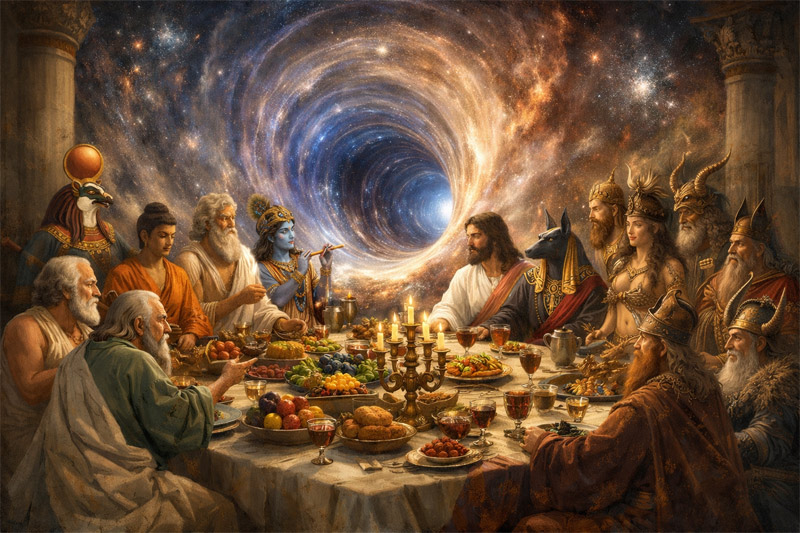
The table stood outside of time.
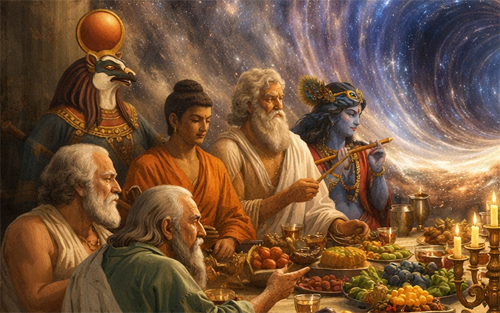
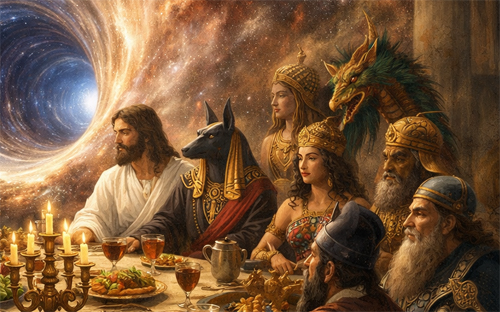
It was long and almost circular, so that no place could be called the beginning or the end. Bread from many lands lay beside fruits unknown to any single climate. Cups reflected firelight, and behind them—quiet, slow, immense—the sky opened into a gentle spiral of stars, like a doorway rather than a destination.
For a moment, no one spoke.
Then an old man with dust on his sandals traced a line on the table with his finger and smiled.
“We have been watching this moment longer than we remember,” he said. “Long before names were given to us.”
A blue-skinned figure beside him nodded, eyes calm, voice soft.
“Before stories,” he added. “Before temples. When people simply noticed that the darkness stopped growing.”
Across the table, a man wrapped in a plain robe leaned forward, warmth in his expression.
“And they gathered,” he said. “Not because they understood the heavens—but because they understood one another.”
A woman crowned with antlers lifted her cup.
“In forests,” she said. “By fires. They shared what little they had. Light was not something they owned. It was something they waited for—together.”
A bearded traveler with a weathered face laughed quietly.
“They feared the dark,” he admitted. “But they also learned from it. Crops sleep in darkness. So do seeds.”
Silence returned—not empty, but listening.
From the far side of the table, a philosopher spoke, fingers steepled.
“They learned something subtle,” he said. “That time is not a straight road. It bends. It returns. And meaning lives in the return.”
A figure with the head of an animal inclined his head.
“They weighed the year,” he said. “They measured breath and shadow. They learned when to rest, when to act, when to wait.”
The blue-skinned figure gestured gently toward the sky.
“Astronomically,” he said, “it is simple. A tilted world turning around its star. No miracle—just motion.”
The man in the plain robe smiled.
“And yet,” he said, “simplicity does not make it small.”
The spiral of light behind them pulsed once, slowly.
“In the northern lands,” said a voice like wind over stone, “this was the longest night. People feared the Sun might not return.”
“In the southern lands,” replied another, “it was the deepest light. Abundance before the turning.”
“Opposites,” said the philosopher.
“Complements,” corrected the forest queen.
They shared a quiet laugh.
“Everywhere,” said the traveler, “people told different stories—but performed the same actions.”
“They cleaned their homes,” said one.
“They forgave debts,” said another.
“They fed strangers,” said a third.
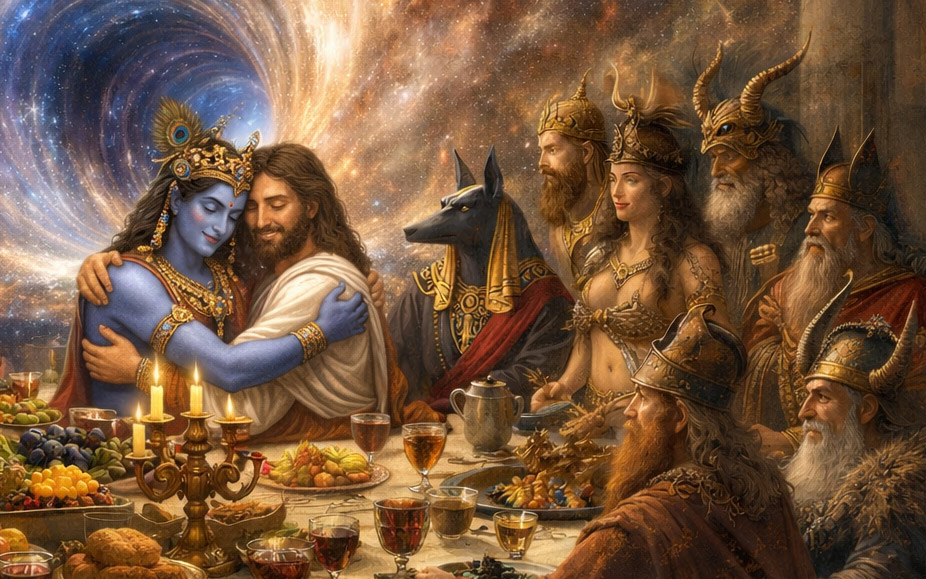
The man in the robe rested his hand on the shoulder of the blue-skinned figure, and they leaned closer—not in hierarchy, but in recognition.
“Light,” one said, “was warmth.”
“Light,” said the other, “was awareness.”
“And darkness,” they said together, “was not the enemy.”
A philosopher raised an eyebrow.
“Modern people forget this,” he said. “They think darkness must be conquered.”
The old man with dust on his sandals shook his head.
“Darkness teaches patience,” he replied. “It teaches listening.”
The fire flickered. Cups were refilled.
“Even now,” said the forest queen, “people pause at this time. Some call it tradition. Some call it psychology.”
“Some call it nothing at all,” added the traveler.
“But they still feel it,” said the blue-skinned figure.
“The body remembers,” said the man in the robe.
Beyond the table, the spiral of stars slowly brightened—not rushing, not demanding attention.
“This,” said the philosopher softly, “may be the only universal ritual.”
“Not belief,” said one.
“Not doctrine,” said another.
“But noticing,” said the old man.
They sat together as the light subtly shifted.
No proclamation was made. No truth declared victory.
Only this remained:
That on a turning world, under a shared sky, people have always paused when the light changes— to gather, to rest, to remember that nothing ends here.
And that, for now, was enough.
An AI Explanation:
The Turning of the Light: A Shared Human Moment
Across human history, long before written language or formal religion, people observed the sky. The movement of the Sun across the horizon, the lengthening and shortening of days, and the rhythm of seasons shaped survival itself. From these observations emerged one of the most universal human ideas: the turning of the light—the moment when darkness stops growing and light begins its return, or when light reaches its peak and slowly yields again to night.
This moment has been marked, celebrated, reflected upon, and ritualized by cultures on every continent. While names, stories, and symbols differ, the underlying themes remain strikingly similar.
Astronomical Foundation: What Is the “Change of the Light”?
Astronomically, the event is simple and precise.
Earth’s axis is tilted approximately 23.5 degrees relative to its orbit around the Sun. Because of this tilt, different parts of the planet receive varying amounts of sunlight throughout the year. This creates two key annual moments:
Winter Solstice:
In the Northern Hemisphere, this is the shortest day and longest night of the year. After it, daylight slowly increases.
In the Southern Hemisphere, it is the opposite—the longest night occurs in June.
Summer Solstice:
The longest day and shortest night in a given hemisphere.
From a physical perspective, nothing mystical occurs in the sky at that instant. Yet for human societies—especially agrarian, pastoral, or hunter-gatherer ones—this predictable turning point carried immense meaning. It marked survival through scarcity, the promise of renewal, or the balance between abundance and decline.
The Oldest Traditions: Fire, Stone, and Sky
The earliest archaeological evidence shows deliberate alignment of structures with solstices. Stone circles, earthworks, caves, and temples across Europe, Africa, Asia, and the Americas reveal a shared impulse: to anchor human time to cosmic time.
Common elements in these early traditions include:
Fire and Light Fire symbolized warmth, life, protection, and continuity. Lighting fires at the darkest point of the year expressed both practical necessity and symbolic hope.
Gathering and Community Solstice moments often brought people together—sometimes because travel became impossible later, sometimes because collective presence reinforced safety and meaning.
Cycles Rather Than Endings These traditions rarely framed the moment as an end. Instead, they emphasized return, rebirth, and continuity.
Importantly, these practices existed long before formal theology. They were observational, communal, and deeply practical.
Agricultural Civilizations: Order, Balance, and Renewal
As societies settled and agriculture became central, the change of the light gained additional layers of meaning.
Common themes across early farming cultures included:
Calendrical Reset The solstice helped structure planting, harvesting, taxation, and labor cycles.
Symbolic Renewal Seeds planted in darkness, resting fields, and stored grain mirrored cosmic rhythms.
Ritual Cleansing and Preparation Many cultures associated this period with cleaning homes, repairing tools, forgiving debts, or reconciling conflicts—social renewal mirroring natural renewal.
Even as mythologies diversified, the underlying focus remained on balance, order, and the reassurance that the world continues.
Philosophical and Religious Developments
With the rise of organized religions and philosophical systems, solstice traditions were often absorbed rather than erased. New narratives were layered onto older frameworks.
Despite doctrinal differences, several shared motifs persisted:
Light as Knowledge or Awareness Light became associated with clarity, wisdom, compassion, or ethical insight—not merely physical brightness.
Darkness as Rest, Not Evil In many traditions, darkness represented gestation, introspection, and potential rather than something inherently negative.
Embodied Ethics Acts of generosity, hospitality, and care for the vulnerable frequently clustered around this season, reinforcing social cohesion during harsh conditions.
These practices were less about belief enforcement and more about behavioral alignment—how people treated one another when resources were scarce and nights were long.
The Southern Hemisphere: A Necessary Counterbalance
A truly global perspective must include the Southern Hemisphere, where the seasonal meanings reverse.
Here, the “change of the light” may occur during periods associated with warmth, growth, or harvest rather than cold and scarcity. Yet the core themes remain consistent:
Recognition of cyclical time
Respect for natural limits
Celebration of continuity rather than permanence
This reminds us that the symbolism of light and darkness is relational, not absolute. Meaning emerges from context, not from the event alone.
Modern and Secular Interpretations
In contemporary societies—scientific, pluralistic, and often secular—the change of the light continues to resonate.
Modern expressions often emphasize:
Reflection and Pause End-of-year reflection, goal setting, and evaluation mirror ancient reset rituals.
Connection Beyond Belief Even among atheists or non-religious individuals, themes of togetherness, rest, and gratitude remain central.
Psychological Light In darker months, attention to mental health, warmth, and human contact echoes ancient survival instincts in a modern form.
Here, the solstice becomes less about cosmology and more about human well-being.
Common Threads Across All Traditions
When stripped of names, symbols, and doctrines, the shared elements are clear:
Awareness of cosmic rhythm
Acceptance of change and impermanence
Hope grounded in predictability, not miracles
Emphasis on community, care, and continuation
Recognition that light and darkness coexist and depend on one another
These are not religious claims. They are human observations.
Conclusion: A Universal Human Gesture
The change of the light is one of the few moments that belongs equally to everyone—regardless of geography, belief, or worldview. It does not demand faith, only attention.
It reminds us that:
Darkness does not last forever
Light does not dominate forever
Cycles are more reliable than certainty
Meaning can exist without uniform belief
In this sense, the solstice is not a religious event—it is a shared human acknowledgment that we live on a moving planet, under a predictable sky, together.
And that, across tens of thousands of years, has been reason enough to pause, gather, and look toward the light—however one chooses to understand it.